
If you’re looking into attic insulation for a home in Chicago, one of the first numbers you’ll encounter is R-value. You’ll see recommendations for R-38, R-49, R-60, and sometimes even higher, which can make a seemingly simple question surprisingly confusing.
We look at attic insulation a little differently. The goal isn’t simply to reach a number on a measuring stick. Your attic insulation needs to work together with air sealing and proper ventilation to create a more complete thermal boundary between your living space and the attic.
For Chicago-area homeowners, R-49 to R-60 is a useful range to understand when evaluating attic insulation, with the appropriate target depending on the home, existing insulation, assembly, applicable code, and goals of the project. Chicago is located in IECC Climate Zone 5A, where both winter heat loss and summer heat gain make the attic an important part of the home’s thermal envelope.
Quick Answer: How Much Attic Insulation Does a Chicago Home Need?
The table below provides a practical starting point for homeowners evaluating an existing attic.
| Attic Condition | Approximate R-Value | What It May Mean |
|---|---|---|
| Little or no insulation | R-0 to R-19 | Significantly under-insulated for the Chicago climate |
| Older or inadequate attic insulation | R-20 to R-38 | Additional insulation and air sealing may be beneficial |
| Common high-performance retrofit range | R-49 to R-60 | Strong target range for many Chicago-area attic projects |
| 2021 IECC reference for an uninsulated attic in Climate Zone 5 | R-60 | Useful benchmark when evaluating insulation performance |
| 2024 IECC prescriptive ceiling R-value for Climate Zone 5 | R-49 | Current model-code prescriptive reference |
Why are there different numbers? Energy codes have multiple compliance paths and have changed between editions. The U.S. Department of Energy’s 2021 IECC guidance lists R-60 for ceilings below uninsulated attics in Climate Zone 5, while the 2024 IECC’s R-value alternative lists R-49 for Climate Zone 5 ceilings. Illinois adopted an amended version of the 2024 IECC effective November 30, 2025. Local requirements should always be confirmed for work requiring permits.
For an existing home, however, determining how much insulation you need involves more than looking up the newest code requirement.
What Does R-Value Actually Mean?
R-value measures how well an insulating material resists heat flow. Generally, the higher the R-value, the greater its insulating ability. That matters in Chicago.
During winter, heat from your living space naturally moves toward colder areas, including an poorly insulated attic. During summer, a hot attic can contribute to heat moving toward the conditioned rooms below. A properly insulated attic helps slow that heat transfer in both directions. +R-value depends partly on the insulation material and its thickness, which is why two attics with the same insulation depth won’t necessarily have the same R-value.
Why R-Value Alone Doesn't Tell Us Enough
R-value measures how well an insulating material resists heat flow. Generally, the higher the R-value, the greater its insulating ability. That matters in Chicago.
During winter, heat from your living space naturally moves toward colder areas, including an poorly insulated attic. During summer, a hot attic can contribute to heat moving toward the conditioned rooms below. A properly insulated attic helps slow that heat transfer in both directions. +R-value depends partly on the insulation material and its thickness, which is why two attics with the same insulation depth won’t necessarily have the same R-value.
Why R-Value Alone Doesn't Tell Us Enough
This is where homeowners can get into trouble simply searching for "how many inches of insulation do I need?" We've inspected thousands of homes throughout Chicagoland, and insulation depth is only one part of what we evaluate.
You could have a substantial amount of insulation and still have an attic that performs poorly. We regularly encounter insulation that has been compressed, disturbed, installed unevenly, or moved away from certain areas. We also find penetrations between the living space and attic that were never properly air sealed. In those situations, simply blowing another layer of insulation over everything may hide the problems without addressing them.
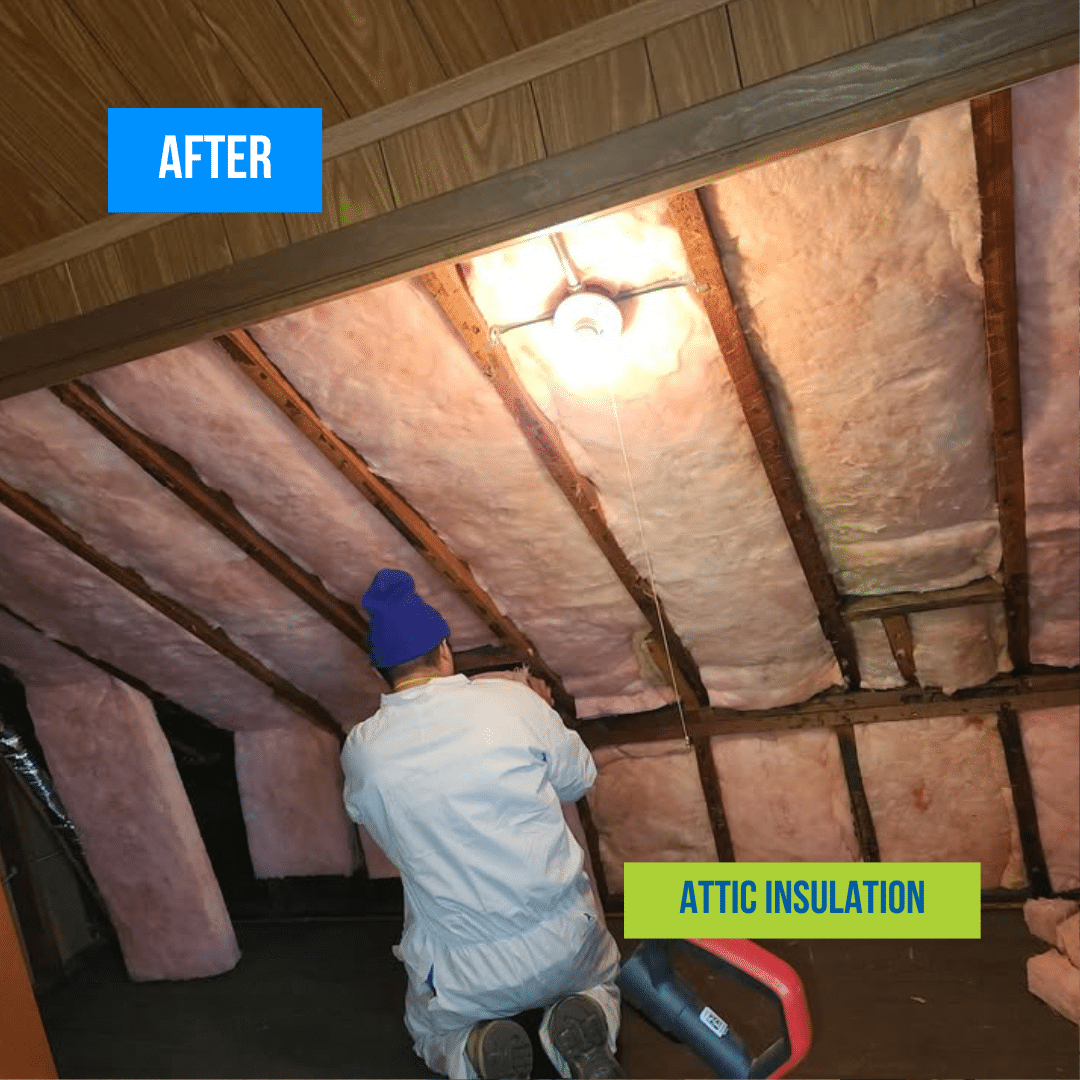
Air Sealing Should Be Addressed With Attic Insulation
One of the most important parts of improving an attic is addressing air leakage between the home and attic. There are numerous openings hidden underneath attic insulation. Electrical penetrations, plumbing penetrations, top plates, attic hatches, and other gaps can allow conditioned indoor air to move into the attic.
During a Chicago winter, that escaping air carries heat and moisture with it. Besides making the home less efficient, warm moist air entering a cold attic can contribute to condensation and other moisture-related concerns. That’s why our team includes air sealing as part of our attic insulation projects rather than treating it as an unrelated service. We want to improve the entire attic system instead of simply increasing insulation depth.
How Much Insulation Is Already in Your Attic?
Before determining how much additional insulation a home needs, we need to understand what’s already there. Older Chicago-area homes can vary dramatically. We’ve inspected homes with very little insulation remaining and others where several different insulation materials have been added during previous renovations. Some attics look well insulated from the access hatch but have thin or completely exposed areas farther away.
We also encounter compressed insulation where homeowners have stored belongings or contractors have repeatedly walked through the attic. The condition and consistency of the existing insulation matter just as much as the depth measured in one location.
Sometimes the Old Insulation Should Come Out
Adding insulation over an existing layer isn’t always the right approach. Our attic insulation process includes removing the old insulation so we can access the attic floor beneath it. This gives us an opportunity to identify and seal the penetrations that would otherwise remain buried.
Removing the existing material also gives us a much clearer picture of the attic’s condition. Problems that were hidden underneath old insulation become visible before the new insulation is installed. Once those conditions have been addressed, the attic can be insulated as a more complete system.
Don't Forget About Attic Ventilation
Insulation and ventilation have different jobs, but they need to work together. A properly designed vented attic allows outside air to enter through lower vents, commonly at the soffits, and exit higher in the roof. Insulation shouldn't block those ventilation pathways.
The 2024 IECC specifically addresses attic insulation installation and requires insulation to maintain its intended thickness rather than being compressed in ways that reduce its installed R-value. During an attic evaluation, we're therefore looking at more than insulation. We want to understand how air moves through the attic and whether insulation is interfering with the ventilation system.

Signs Your Chicago Home May Need More Attic Insulation
You don’t necessarily need to climb into your attic with a ruler to recognize that something may be wrong. Homeowners often call us because the second floor is noticeably hotter in summer or colder in winter. Others notice drafts, rooms that are difficult to keep comfortable, or heating and cooling equipment that seems to run constantly.
Those symptoms don’t automatically prove you need more insulation. Air leakage, HVAC problems, duct issues, windows, and other parts of the home can produce similar symptoms. That’s another reason an attic should be evaluated rather than assuming additional insulation will solve every comfort problem.
What We Commonly Find in Chicago Attics
After inspecting thousands of homes throughout Chicagoland, we’ve learned that attic insulation problems are rarely as simple as “there isn’t enough.”
We find areas where insulation is missing entirely, insulation that has been compressed or disturbed, attic penetrations that were never air sealed, ventilation openings that have been covered, bathroom exhaust fans terminating improperly, and ductwork that has become damaged or disconnected.
Those conditions can exist even in an attic that appears to have plenty of insulation. That’s why our first question isn’t simply, “How many inches are up here?” We’re trying to determine whether the attic is actually performing the way it should.
So, What R-Value Should You Aim For?
For Chicago-area homeowners researching an attic insulation upgrade in 2026, R-49 to R-60 provides a useful range for understanding a well-insulated attic, but the appropriate specification should be determined based on the home and applicable requirements.
The current 2024 IECC model-code R-value table lists R-49 for Climate Zone 5 ceilings, while DOE’s guidance based on the 2021 IECC lists R-60 for an uninsulated attic in Climate Zone 5. Illinois’ amended 2024 IECC became effective November 30, 2025, and Chicago maintains its own local energy code requirements.
More importantly, don’t assume reaching R-49 or R-60 automatically means the attic is performing well. The insulation needs to be installed correctly, air leakage needs to be addressed, and ventilation needs to continue functioning as intended.
Contact Us for Attic Insulation in Chicago
If your upstairs is difficult to keep comfortable, your energy bills seem unusually high, or you’re unsure whether your attic has enough insulation, we can help.
Our team evaluates attic insulation throughout Chicago and the surrounding suburbs with more than insulation depth in mind. We’ll look at the condition of the existing insulation, air leakage, ventilation, and other attic conditions before recommending improvements.
Contact us to schedule your free attic insulation evaluation and find out what your home actually needs.