Concrete leveling can often be done in cold weather, but whether it can happen on a given day depends more on conditions under the slab than on the calendar. For exterior slabs in a Chicago winter, the main limit is frozen ground. If the soil beneath a driveway, walk or step is frozen, we postpone the lift until it thaws. Interior slabs depend much less on the weather, and any slab can be assessed now even if the lift itself has to wait.
Much of the cold-weather concrete advice online is about pouring and curing new concrete. Leveling raises a slab that already exists, so those rules apply differently. Our page on concrete leveling in Chicago covers the service itself, and this guide focuses on timing.
Lifting a Sunken Slab Is Not the Same as Pouring New Concrete
Questions such as how cold is too cold to lay concrete, or whether concrete will cure just above freezing, are about fresh pours. Cold slows hydration, the chemical reaction between water and cement that makes concrete harden, so new pours in cold weather need protection, careful timing and extra curing time. If fresh concrete freezes before it has cured, it can crack or end up weaker. Those concerns matter if your slab needs replacing, because replacement is a new pour. They do not govern lifting a slab that cured long ago.
Lifting methods include mudjacking, which pumps a heavy cement-based slurry under the slab, stone slurry grout leveling and polyurethane foam injection. Each one has its own cold-weather considerations. We use PolyLevel, a high-density polyurethane foam system. Our crews drill small injection holes in the slab and inject foam that expands to fill voids and gradually lift the concrete toward its intended position. The foam is lightweight, water-resistant and fast curing, but like any lifting material, it still has to go into a slab, soil and jobsite environment that suit it.
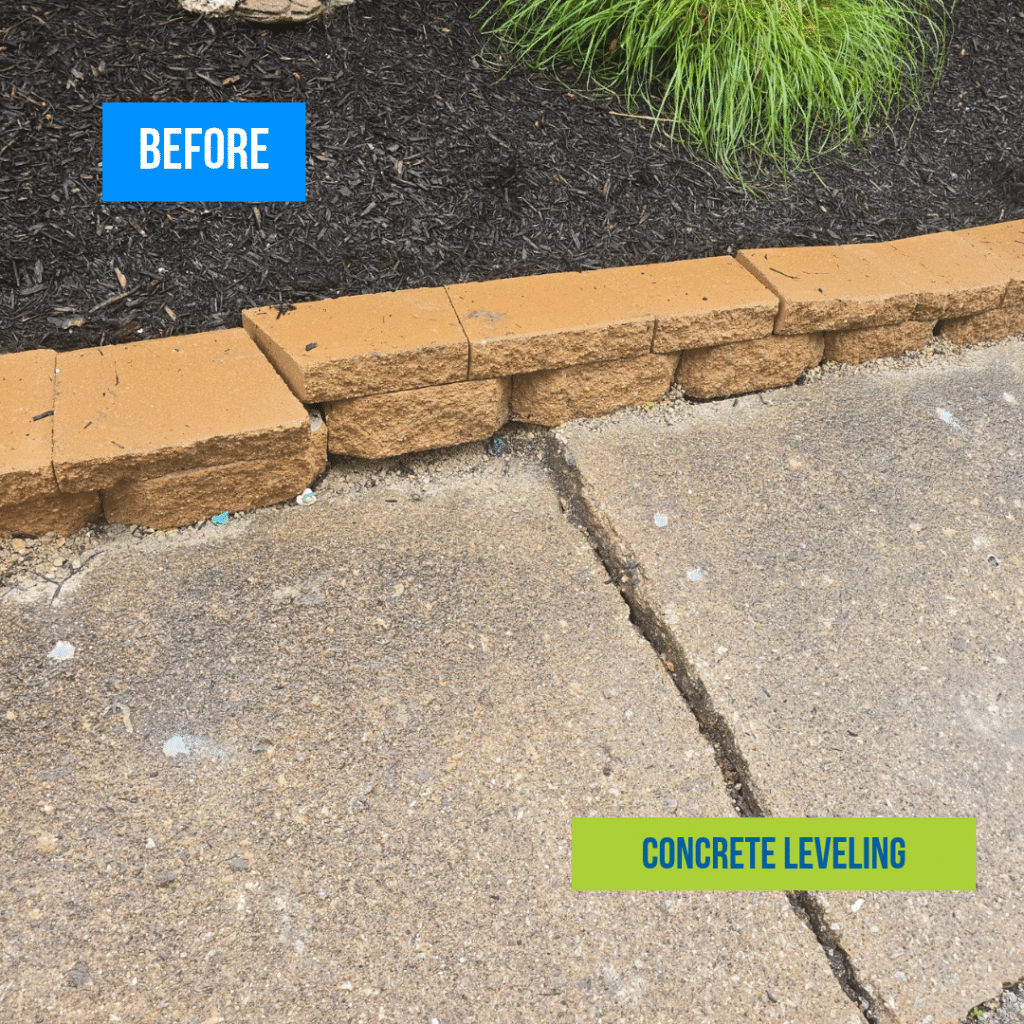
Frozen Ground Is the Real Limit, Not Just the Air Temperature
Cold air on its own does not automatically stop a lift. What stops exterior work is frozen soil beneath the slab, which can keep the concrete from moving as planned. Installing material under a slab in that condition can interfere with an effective, stable repair, and frozen ground is a documented reason we postpone polyurethane lifting. No single air temperature tells the whole story, so we judge the actual slab and soil on site.
Air temperature still plays a part, since it affects how quickly the ground freezes and thaws. Sun exposure matters too. A slab in full sun can warm the soil beneath it, while a walk along the shaded side of the house may stay frozen longer. On the same property, one slab can be ready while another still has to wait.
Winter also makes slabs harder to read. Moisture in the soil can freeze and expand, temporarily pushing a slab upward, and the slab may move again when the ground thaws. A section that looks raised in January may be heaved rather than permanently out of place, so we need to tell temporary frost heave apart from real settlement before choosing which section to lift. If a slab’s position is still changing with the weather, we may postpone the repair and reevaluate it after the thaw.
Which Slabs Can Be Leveled in Winter and Which Should Wait
Interior slabs, such as basement floors, generally remain a workable option through the season. Driveways, sidewalks, patios, front steps, porches and AC pads are the slabs that depend on conditions. For a garage floor, we check whether the soil underneath is frozen rather than assuming either way.
Some problems do not wait well. A sunken step or sidewalk lip used every day becomes a bigger trip hazard on icy mornings, and a home sale, inspection or renovation can put a deadline on the repair. In those cases, it makes sense to have the slab assessed right away so a lift can happen on the first suitable day. When the problem is mostly cosmetic, or the slab looks different in winter than it did in fall, waiting for thawed ground is often the better call.
Lifting is also not the right fix for every slab. We recommend PolyLevel when the concrete is structurally sound but has settled because of soil movement, erosion or voids underneath. A slab that is severely cracked, crumbling or deteriorating may be better replaced, which brings back the pouring and curing concerns above, and our guide on whether cracked concrete can still be leveled explains where that line falls. For a minor lip between otherwise stable slabs, grinding the raised edge may be enough, although grinding does not correct the settlement underneath. We compare those two options in our article on whether grinding or leveling is the better fix for a trip hazard.
What Chicago’s Freeze-Thaw Winters Do to a Slab After It Is Lifted
Chicago winters bring repeated freezing and thawing, along with snowmelt and de-icing salt on driveways, sidewalks and steps. We cover how that cycle cracks and moves concrete in a separate article on freeze-thaw damage to sidewalks, driveways and steps. After a lift, the concern is narrower: water getting back into the soil beneath the slab. Open joints, cracks and gaps along the house let rain and meltwater reach the supporting soil, where it can contribute to erosion, settlement and freeze-thaw damage. Downspouts that empty next to a slab do the same thing in a concentrated stream.
After lifting and stabilizing concrete, we can seal cracks and joints with NexusPro, a flexible silicone-based sealant designed to resist water infiltration, ultraviolet exposure and seasonal temperature changes. Depending on the project, sealing can include gaps between concrete sections and next to the foundation. We also look at drainage around the slab. Where runoff is contributing to settlement, we can recommend downspout extensions or yard drainage improvements.
How Cold Weather Changes Scheduling
Late-fall and winter dates for exterior leveling depend on the weather. A job booked for a workable week may still need to move if the ground freezes before the crew arrives. When conditions prevent a proper installation, we reschedule until the ground thaws and the slab can be evaluated again. In the past, that has meant moving polyurethane lifting work to spring, with an earlier appointment if the weather improved enough to allow installation.
Conditions also vary across the area we serve, from Chicago and its suburbs to Northwest Indiana, so the ground may be workable in one town and still frozen in another. None of that prevents an assessment. During a consultation, we look at the slab’s condition, the direction it has moved, the drainage around it and the underlying soil. From there, we recommend lifting, grinding, replacement or waiting.
Our published projects include sunken entrance steps in Arlington Heights that our team lifted and stabilized with PolyLevel, and a Chicago driveway and sidewalk we leveled and then joint-sealed. Our concrete lifting carries a standard five-year transferable warranty, with an optional upgrade to ten years. The exact terms, limits and exclusions are set by the written agreement for each project.
A Pre-Winter Checklist for Sunken or Uneven Slabs
A few checks before the first hard freeze will make any winter decision easier, whether you call us or not.
- Photograph each problem slab and measure the height difference at the worst lip or gap, so you can tell later whether it changed over winter.
- Note where water pools after rain or snowmelt and where each downspout discharges.
- Confirm that gutters and downspouts work, and that roof runoff and the surrounding grade send water away from slabs and the foundation.
- Look for open joints, cracks and gaps between slabs and along the house.
- Look for voids or washed-out soil visible at slab edges.
- List the slabs you use every day in winter, such as the front steps, main walk, and driveway, and decide whether any of them is a safety hazard that cannot wait for spring.
Bring those notes and photos to a consultation. Measurements taken in fall make it easier to tell frost heave from settlement later, and drainage notes help us judge whether a slab needs lifting, sealing, drainage work or only monitoring.
If you have a sunken step, walk, driveway or patio and are unsure whether to act before winter, start with an assessment rather than a guess based on the forecast. We offer free consultations across Chicago and Northwest Indiana, and we do not upsell or use high-pressure sales. If waiting for spring, grinding or replacement is the better choice for your slab, we will tell you. Call 1-800-421-7325 to set up a free consultation.